Plumbing SWMS for Plumber Contractors
The site-specific SWMS builders demand before your crew can start. Generated for plumber contractors in about 4 minutes, checked against our library of current state WHS citations, A$39 flat.
Trade packs from A$179 · toolbox talk pack (24 talks) +A$24 at checkout
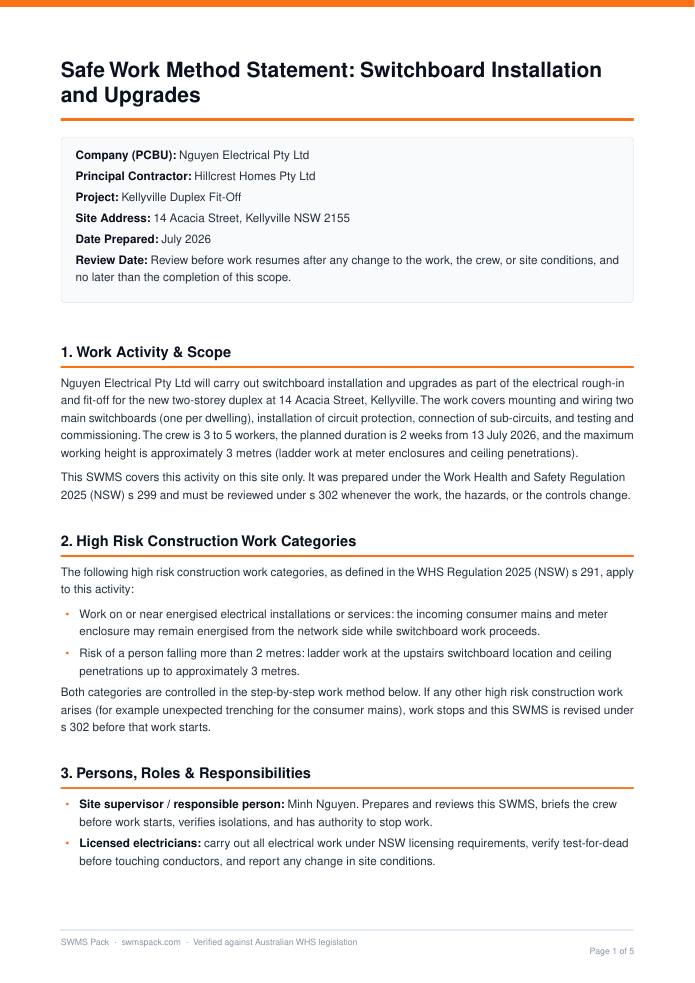
When you need this document
A builder or principal contractor is asking for a site-specific SWMS before you can get on the job, or your work falls under a high risk construction work category and the law requires one before work starts.
What it covers for plumber work
Typical hazards addressed: trench collapse, confined space atmospheres, underground service strikes, falls from roofs and ladders, sewage and biological exposure, hot work on pipework. Citations from the Plumber focus list:
- §reg 304: the person with management or control of the workplace must take all reasonable steps to obtain current underground essential services information for the excavation area and adjacent areas before directing or allowing the excavation to start, and must give it to any person it engages to carry out the excavation; that person, and any business given the information, must have regard to it. A contractor that does not manage or control the workplace gets the information from the person with management or control of the workplace (normally the principal contractor) before excavating
- §reg 305: manage the risks of any excavation work under Part 3.1, including a person falling into the excavation, being trapped by its collapse, being struck by a falling thing or exposed to an airborne contaminant, having regard to the nature of the excavation, the work method and the means of entry and exit. Barricading or isolating the area around an excavation shallower than 1.5 m is a control under this duty (with reg 36), never under reg 306
- §reg 306: before excavating a trench at least 1.5 m deep, secure the work area from unauthorised access and support all sides by shoring, benching or battering, unless a geotechnical engineer advises in writing that the sides are safe from collapse. The duty applies to a trench 1.5 m deep or deeper. It sets no inspection frequency, so trench inspection is written as good practice without this citation. Securing the area around a shallower excavation is NOT this duty (see reg 305)
- §reg 291: high risk construction work includes work in or near a shaft or trench with an excavated depth GREATER than 1.5 m, or a tunnel ("deeper than 1.5 m" is correct for this category; the reg 306 support duty applies at 1.5 m)
- §reg 62 to reg 77: confined spaces (pits, tanks, sewer access); risk assessment under reg 66, entry permits under reg 67
- §reg 78 and reg 79: managing the risk of falls (roof plumbing, ladder work)
- §reg 166: when working near an overhead or underground electric line, no person, plant or thing may come within an unsafe distance of it; where that is not reasonably practicable a risk assessment and control measures are required
- §reg 44 to reg 47: PPE duties
- §AS/NZS 3500: plumbing and drainage (the technical standard the plumbing work itself is carried out to)
- §AS/NZS 5601.1: gas installations (gas line installation, purging and testing for leaks before commissioning)
- §AS/NZS 2865: confined spaces (entry permits, atmospheric testing and stand-by person for pits, tanks and sewer access)
- §Asbestos and plumbing work: the asbestos demolition and refurbishment lines that follow apply to plumbing work only where the job is refurbishment that disturbs the structure itself (for example cutting into walls, floors or wet area linings, or cutting out or removing old pipes, flues or vent stacks) in an older building, structure or plant that the application line covers (built or installed before the date it gives). Minor or routine maintenance work, and other minor work, is excluded. On a job that does not disturb the structure in such a building, do not state these duties as applying
- §reg 447: the asbestos duties for demolition and refurbishment (reg 448 to reg 457) apply to the demolition or refurbishment of a structure or plant constructed or installed before 31 December 2003. Demolition or refurbishment does not include minor or routine maintenance work, or other minor work. Where these duties apply they are law, never good practice
- §reg 448 to reg 450: before demolition or refurbishment starts, the person with management or control of the workplace must ensure the asbestos register is reviewed (and revised if it is inadequate for the proposed work) and that the business carrying out the work is given a copy, and the business carrying out the demolition or refurbishment must obtain a copy of the asbestos register from the person with management or control of the workplace before it starts the work
- §reg 451: where there is no asbestos register for the structure or plant, the business that is to carry out the demolition or refurbishment must not carry it out until the structure or plant has been inspected to determine whether asbestos or ACM is fixed to or installed in it, and must ensure that the determination is undertaken by a competent person. It must assume that asbestos or ACM is fixed to or installed in the structure or plant if the competent person is, on reasonable grounds, uncertain, or if part of the structure or plant is inaccessible and likely to be disturbed. If asbestos or ACM is determined or assumed to be present, it must inform the occupier and the owner of the premises (residential premises) or, in any other case, the person with management or control of the workplace
- §reg 456 and reg 457: all asbestos that is likely to be disturbed by the refurbishment must be identified and, so far as is reasonably practicable, removed before the refurbishment is commenced. For residential premises this is the duty of the business carrying out the refurbishment (reg 457); for any other workplace it is the duty of the person with management or control of the workplace, or of the structure or plant (reg 456)
What's inside
- ✓ Title block: PCBU, principal contractor, site address, prepared and review dates
- ✓ High risk construction work categories identified for your activity
- ✓ Step-by-step work method with hazards, risk ratings, and controls
- ✓ Controls in hierarchy order: eliminate, substitute, isolate, engineer, administer, PPE
- ✓ Plant, equipment, permits, licences, and training requirements
- ✓ Emergency procedures and review triggers
- ✓ Your state’s legislation cited (WHS Regulation, or OHS Regulations in Victoria)
- ✓ Worker consultation and sign-off block
What a safe work method statement costs everywhere else
Same document, three very different price tags and wait times.
| Safety consultant | Template shops | SWMS Pack | |
|---|---|---|---|
| Price | A$250 to A$1500 | A$19 to A$88 per template | A$39, packs from A$179 |
| Turnaround | 3 to 10 days | hours of DIY editing | ~4 minutes |
| Site-specific to this job | Yes | No, you fill in blanks | Yes |
| State-correct citations | Yes | Often generic or stale | Yes, verified against 80+ WHS citations |
| Victoria handled correctly | Yes | Rarely | Yes, OHS Regulations branch |
| Revisions when the builder asks | Billed hourly | You edit it yourself | Free within 24h |
Common questions
▸How fast can I get a safe work method statement?
About 4 minutes after the 10-minute questionnaire. It downloads instantly and a copy lands in your email.
▸Does it cover the WHS requirements for plumber work?
Yes. Plumber documents are generated against a curated WHS focus list for the trade, and every regulation and Australian Standard citation is validated against a verified citations table before delivery. Victorian orders are written to the OHS Regulations 2017 instead.
▸What if the builder or principal contractor asks for changes?
Reply to your delivery email and we revise the document free within 24 hours.
Plumber SWMS by state
Your SWMS is written to your state's legislation. Victoria uses its own OHS Regulations; the other states and territories follow the harmonised WHS laws.
Plumber SWMS NSWPlumber SWMS VICPlumber SWMS QLDPlumber SWMS WAPlumber SWMS SAPlumber SWMS TASPlumber SWMS ACTPlumber SWMS NT
Safe Work Method Statement for other trades
ElectricianCarpenterRooferScaffolderConcreterBricklayerPainterTilerDemolitionExcavation / EarthmovingSolar Installer
Free tools and guides
Free SWMS template (PDF + Word)Plumbing SWMS: full free sampleWorking at heights SWMSExcavation SWMSConfined space entry permitSWMS vs JSA: the differenceSWMS requirements by stateThe 18 HRCW categoriesAll WHS documents for plumbersSWMS cost calculator